


A century of New Prague baseball
Ed’s note: This story appeared in the 2026 MBA state tournament program and is reprinted with permission. The program became a great success and sold out thanks in part to the dedicated hard work of Bob and Gerilee Greeley, in addition to all the work of the diligent writers who contributed to the program. This is a first of a series of stories that appeared in the program. By Nick Schoenecker The New Prague community has a rich baseball tradition dating back to the mid-1890s. On any given day, conversations in downtown New Prague might turn to the diamond. Whether discussing a Sunday afternoon game, debating which team local high school seniors will join, or comparing modern squads to the powerhouses of yesterday, baseball remains the area’s common language. Town team baseball began in the late 1890s with the New Prague Red Caps. The name soon changed due to the influence of the local flour mill owned by Francis Atherton Bean. The mill’s “Seal of Minnesota Flour” was exported worldwide, and the ballclub adopted the name, becoming the “Seals.” In 1925, the Seals made their first and only state tournament appearance. By 1939, when the mill’s product changed to Robin Hood Flour, the team followed suit, rebranding as the Robin Hoods. Mike Rybak, known as “Mr. Baseball,” was the architect of the game’s local growth during the 1900s. A powerful hitter in the 1920s and 30s — once hitting a home run measured at nearly 500 feet — Rybak brought the sport back to New Prague after WWII by organizing the Robins. He later helped start the Orioles in the Dakota-Rice-Scott (DRS) League. For decades, his impact was immortalized on the scoreboard at Mike Rybak Field. In the 1950s, the Robins competed in the Minnesota River League with a mix of local talent and paid players from the Twin Cities. Some were genuine celebrities, such as Slater Martin, a five-time NBA All-Star, who spent a summer playing shortstop for the Robins. At the time, top pitchers could earn $100 a game — a significant sum for the era. The Robins were also known to recruit and bring in Gophers baseball players, many used the payments to cover their tuition for the next year. While the Robins played competitive ball throughout the 50s and 60s, they narrowly missed state berths, including a heartbreaking loss in 1955 to eventual state champions St. Peter. To adapt to new radius rules instituted by the Minnesota Baseball Association Board of Directors, New Prague began recruiting players to live in the community, often by offering teaching jobs. One such recruit was Tom Preston. His 1954 interview with the school board famously took place under a grandstand after a game; his hiring was contingent on him playing for the Robins. Preston became a legendary catcher and manager, eventually coaching the New Prague High School team from 1954 to 1982. Doug Shonka and Chub Ebnet were two other teachers that were lured away from other amateur teams when given jobs teaching at New Prague High School and played for the Robins. The amateur landscape shifted in 1948 with the creation of Class B baseball and the DRS League. Unlike Class A, Class B forbade paying players and required rostered players to live within a 15-mile radius. New Prague formed a second team, the Orioles, to compete in the DRS. Young players often started with the Orioles before moving up to the Robins. However, as the Minnesota River League moved away from paid players in 1958, it became difficult to support two teams. The Orioles eventually folded, and by the 1970s, the Robins also struggled to compete. In 1978, Rodney Rud reestablished the New Prague Orioles in the DRS League, the same year the New Prague Robins folded up. This “upstart” team found quick success. In 1983, the Orioles posted an 18-5 record and qualified for the state tournament — New Prague’s first appearance since 1925. This sparked a golden era; the Orioles reached 11 state tournaments over the next 14 years. Much of this success was driven by Rud’s leadership and a core of elite talent, including the Schmitz brothers (Ken, Bob, and Brad) and pitching aces Dale Lapic and Joe Hoffman. The 1990s saw this veteran core joined by a new generation of players like Brad Bartyzal and the Dillon brothers. This group made a deep run in the 1997 state tournament, finishing fourth after defeating powerhouse teams like Morris and Springfield. Following a rebuilding period in the early 2000s, the Orioles returned to form in 2010 under manager Jerry Plambeck. Anchored by pitchers Chris Hartman and Chad Skluzacek, and supported by a stout defense, including Dan Shetka and Tyler Seurer, the team returned to the state tournament for the first time in 13 years. Over the next eight years, this group made four state appearances. The most memorable recent run occurred in 2017 at the Green Isle-Hamburg-Norwood tournament. The Orioles won four thrilling games, highlighted by James Fuerniss’ ninth-inning three-run homer against Watkins and Austin Bachman’s 10th-inning double to beat Sobieski. The next year New Prague hosted its first state tournament with partners Shakopee and Jordan. The Orioles made a small run to the final weekend before falling to a good Kimball team. That marked Plambeck’s final game as manager and Nick Schoenecker succeeded him. The Orioles made state tournament appearances in 2020 and 2021. New Prague baseball has seen a century of evolution — from the transition back to wooden bats to major field upgrades. While the names on the jerseys have changed from Red Caps to Robins to Orioles, the spirit remains the same. Each summer, the fans still show up, the beer is still cold, and the quest for another state tournament run continues.
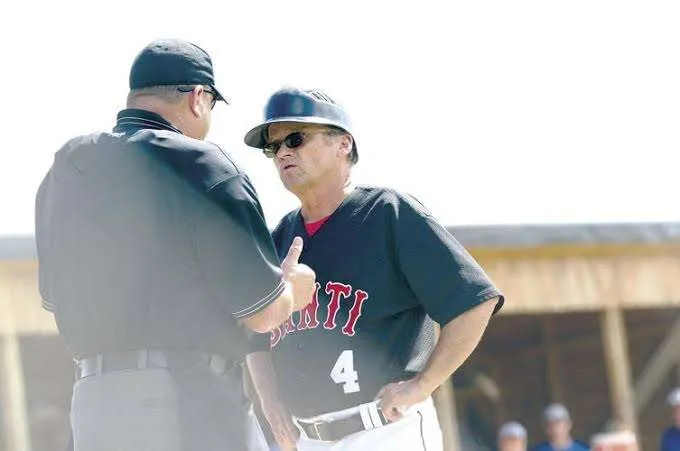
Allen never sought the spotlight, but found success
This story originally appeared in the County News Review and is reprinted with permission By John Wagner The Isanti Redbirds carried a 2-0 lead into the bottom of the eighth inning of their District 1B contest against Cold Springs on Saturday, Aug. 15. “Our guys are playing well. They’re relaxed, and we’ve just scratched out another run in the top of the eighth,” Manager Steve Allen said. “And their crowd was quiet. Then Cold Spring got a couple of bloop hits to start a rally, and the crowd just broke loose. “Suddenly it was boom.” That boom came from a nine-run Cold Spring onslaught that turned into a 9-2 loss to end the Redbirds’ season. Little did the Isanti town ball team know it was about to suffer another loss. Two days later Allen announced he was stepping down after more than two decades as manager of the Redbirds. “After the game, I knew I was done,” he admitted. “I just, I knew it. But I wanted to make sure that I talked it over again with [my wife] Rita before I did anything. “And I didn’t share that at that time because I didn’t want to be in the spotlight. I wanted the players to remember the season, the good times, and the friendships they had developed.” A long-time teacher in the Cambridge-Isanti school system, Allen helped form Cambridge-Isanti Competitive Baseball, the area’s youth baseball organization, while his sons Matt and Ryan were young. That was around 2001; at the time the Redbirds organization, which had a long history of success, had dropped from the town ball rolls. “There were a lot of good people that I worked with when the CICB was formed,” Allen said. “Around that time, a few folks pulled Cindy Livingston and I aside and asked if we would be willing to take over the Redbirds.” Looking back, Allen remembers that it wasn’t an easy decision to bring the franchise back to life. “We had to go in front of the Eastern Minny League, and they questioned us as if we were a bunch of nobodies,” he said with a laugh. “I don’t think we knew how financially solvent at the time the Redbirds were. The folks that ran the team had walked away for a reason. “I remember that decision being very, very difficult. Cindy and I asked each other if we really wanted to do this. We decided that we did, because if we didn’t, our kids would probably be done with baseball.” Allen admitted the franchise struggled in its early days. “When we first started out, we weren’t a very good team,” he said. “We were using high school kids, and our winning percentage was not very high. But we always played hard. It took us some time to learn what it took to be a good team.” When Allen and the Redbirds learned those lessons, they turned them into state appearances. Isanti advanced to the Class C state tournament five times in a six-year span from 2019-24, and before that they made a number of appearances in previous state tournaments. The most notable state performance was posted by the 2011 squad, which won the Class c state title. “I don’t remember that team ever being nervous,” Allen said of that championship team. “It was like a fine-tuned business that’s running on all cylinders. That was a group of guys who all played the game the right way.” Allen said he hesitated to name specific standouts from that team, because he feared missing an important name. “They were a lot of classy individuals,” he said. “It was a group of guys who were baseball fanatics, who really knew how to play the game. I don’t know if we were bigger, stronger, or faster than anybody else, but we surely were on the same page.” But Allen said the organization’s success was measured in ways beyond state tournament appearances. In particular, he relished the friendships that were forged. “Bud Heifort helped me coach this year, and Bud played for St. Francis — and I hated St. Francis early on,” Allen said with a smile. “And Bud’s dad, Tom, still comes to our games. Once Bud and I were talking about drafting players [for the state tournament], and he asked if I remembered when we wanted to draft him, and I sent Packy Lind over to ask if he would play with us — because it was not a given. … “When I see people, they remember a story, maybe remember something that happened along the way.” Allen had a hand in those memories as he served as team manager — a job that involved much more than showing up at the ballpark and filling out the lineup card. When asked about his responsibilities, he spent five minutes talking about field maintenance and stadium upkeep, uniforms, concessions, budgets — and not once talked about procuring players, which is perhaps the most difficult task of all. The variety of tasks makes managing a successful town ball team a year-round job — which is why Allen wasted no time stepping down. “Part of the reason that I wanted to make this decision right away is I knew if I didn’t, I would start thinking about next year,” he said. “The Eastern Minny is a great league, and I’m going to miss them, but they gave me grief because I start scheduling games in November. I think they passed the bylaw to try to make me wait till at least January. … “I know there’s three and a half dozen baseballs there for next year, and I know we need six dozen — so I would order some. I would start thinking about what’s going to happen with the uniforms. I would start to create a budget. And then I would start talking to players about next year.” Rest assured that Allen won’t miss the time spent on that work. But he will miss the interactions with players and their families as well as followers of the team. “I’ll miss the people the most. There’s no doubt about it,” he said. “Whether it be the people on our team or in the league, I’ll miss the people. There’s a husband and wife, the Dooley’s, that I text them any changes in the schedule because they follow us. They were in Cold Spring for the tournament. They’ve been following us for a few years now.” Why did Allen decide to retire? “During the course of the season, there were times when I was physically exhausted, and probably mentally or emotionally exhausted, too,” he admitted. “I was at the point where [I realized] there’s life after baseball. “I don’t think I ever noticed that before, that I was exhausted. There are times when you’re at the field for an evening game at four o’clock, and you don’t leave till 11 o’clock, then you get home and you put stats in the computer. Then you’re looking at the clock, and it’s one, two o’clock in the morning.” What will Allen do with his new-found free time? Believe it or not, he will be chopping a lot of wood. “I probably have wood for 10 years that’s all cut, marked and covered,” he said. “I’ll be burning 2017 and ‘18 wood. And I enjoy it. My wife has offered to buy me a splitter, but I don’t know. I do it all by hand. … “We have a new wood stove that is really, really efficient — but it takes 19 inch logs. All my logs were cut at 24 inches. So every time I go out to start a roll of wood, I have to cut one to three inches off of every log.” On a more serious note, Allen said he will be able to spend more time watching his grandsons, Laithen and Breck, who are competing in cross country, track and skiing at Mora. “I do a lot of photography, and hopefully I’ll do more photography,” Allen said. “Before this, I just haven’t had time. And Rita has learned to travel without me, so hopefully I can help her unlearn that.” Speaking of his wife of more than five decades, Allen said Rita tops the list of people he thanks for his long and successful run. “She’s eligible for sainthood,” Allen said of his wife. “She never once said, ‘Why do you have to go or do something? Are you sure you have to be that long?’ She has always been a hundred percent supportive. … “A couple of years ago, when she took over the concession stand, she never complained about it. The thing is, when she started doing the concessions, I think that was strategic on her part because it gave her a chance to be at games.” Allen said he also took great satisfaction in coaching his sons. “Getting a chance to coach them one year was really special,” Allen said. “And then I got to watch the grandkids come to our games, get bubble gum from the dugout, and then afterwards race around the field. And they’d help Rita in the concession stand.” Allen said the list of other to thank was so long, he feared missing an important name in the community. But his thanks to everyone who supported the Redbirds was real. “There’s people in the community that really support us who we can’t thank enough,” he said. “It’s also been fun over the years to have people come up to me and say, ‘You know, I used to play for the Redbirds’ or ‘My grandpa used to play for the Redbirds.’ “I thank Cindy Livingston for all of her hard work, and I need to thank Dave Englund, because he makes sure Redbird Field is well taken care of. Everyone in our organization has been critical to our success.” But the linchpin of the Redbirds success is Allen, who did his best to avoid the spotlight — whether it was following that final game this season, or the numerous successes the Isanti Redbirds enjoyed through the years. “I did not want to do this announcement,” he said. “I debated whether I should just wait a little bit, but the decisiveness of the decision is really important for me. “Matter of fact, I said to Rita, ‘We do have to start scheduling some bike trips and some other stuff, because otherwise something else [with the Redbirds] is going to slide right in that time period’.”
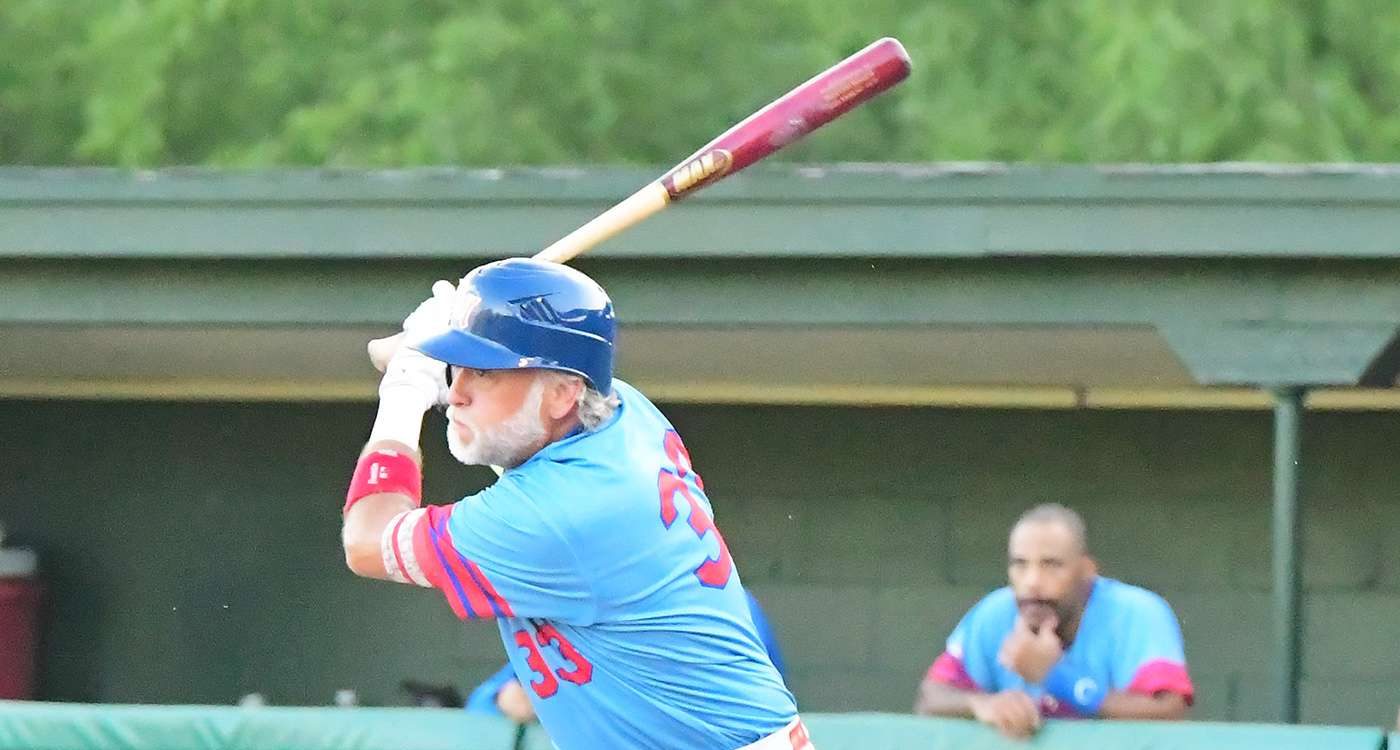
Tonka’s ‘King of Diamonds’ still going at 53 Schmitz finds his Fountain of Youth on town baseball field
This story originally appeared in the Sun Sailor and is reprinted with permission By John Shermanjohn.sherman@apgecm.com There wasn’t a lot of fanfare this season when Minnetonka Monarchs town team baseball veteran SteveSchmitz embarked on his 34th season in the Minnesota Class A ranks. For Schmitz, it wasn’t a big deal to still be playing at the top level of amateur baseball in the state at theage of 52. He didn’t expect a gold watch or recognition by PA announcers at various parks. He wascontent to enjoy the ride and maybe help a few of the Monarchs’ younger players along the way.When the Monarchs qualified for the State Class A Tournament this summer, Schmitz had not played inenough Riverview League games to suit up for postseason action. That broke a string of playing in 24state tournaments – One with the Hopkins Berries, 21 with the Minnetonka Millers and two with theMonarchs. LONGEVITY RECORDSchmitz turned 53 early in August and said he has no plans to retire from Class A town ball. With his firstat-bat in 2027, he will set an all-time Class A record for seasons played with 35. Jim Botten fromMinneapolis is the other player with 34 years of Class A town ball on his resume. Remember how Topps Baseball Cards used to detail season records for players on the back? It would taketwo full cards to list all of Schmitz’s seasons. “When I was in my 30s my dad told me that my body would eventually fail,” Schmitz said last week. “Inever felt that my body was failing in my 40s. When I reached 50 I began taking an extra Advil once in awhile.” Blessed with the eye of a hawk and physical talents that he honed as a three-sport letterman at HopkinsHigh in the early 1990s, Schmitz never intended to be playing town ball 34 years after his debut seasonwith his hometown Hopkins Berries in 1993. HARD TO WALK AWAY“I’ve thought about retiring for 14 years or so, but it’s hard to walk away,” Schmitz said. “I findenjoyment in helping the young guys and showing them that they can play this game for a long time.” Is there anything else that keeps Schmitz coming back year after year? “I can still hit,” he said. “I played in five games this year and had a hit in every game.” The highlight of his season was a 10-8 comeback win over the Chaska Cubs in early June. He played allnine innings and even turned a double play as the middle man at second base. Also playing that night washis 43-year-old friend and teammate, Brandon Broxey, who went three-for-four at the plate. “We had huge smiles on our faces after that game,” Schmitz said. In another game this year, the Monarchs traveled to St. Bonifacius and won with Schmitz going three-for-four. “Granted, St. Boni has a short fence in right, but I felt pretty good about hitting a ball off the top of the wall,” Schmitz said. In getting to know some of the Monarchs’ new players this season, Schmitz has noticed the commitmentand talent of the entire group that includes catcher Reid LaFrenz, first baseman Gus Berger, infielders EliCharney and Jacob Musgjerd, outfielders Drew Dillon and Kyle Boutwell, right-handed pitcher MaxNelson and left-handed pitcher Collin Mitchell. “[Player-manager] Mike Davis brought in a great group,” Schmitz said. “Mike, himself, is playing great.” HOY’S INFLUENCEDuring his years with the Minnetonka Millers, Schmitz helped the team win 11 state Class A amateurchampionships. In all, the Millers won a state-record 15 state crowns under hall-of-fame manager KevinHoy. “I played 13 seasons with the Millers and that seemed like a lifetime,” Hoy said. “Schmitty has playedalmost three times as long as I did. It’s unbelievable. The fact he’s still playing is a testament to how hestays in shape. To this day, he is an aggressive hitter in every sense. Schmitty sees the ball, he hits the ball.He hardly every strikes out.” When Schmitz was still with the Hopkins town team in 2002, a conversation after the last game changedthe course of his career. “Kevin [Hoy] told me that I could play shortstop and bat third for the Millers,” Schmitz recalled. “Someof my Hopkins teammates were talking about retiring, and I couldn’t wait to make the switch toMinnetonka. Playing for the Millers was one of the neatest experiences I could have had. We had our bestteam in 2004 with a 54-3 season record. The franchise had already won four state titles before I joined.Then we won 11 more. I had so many great teammates and we were like a family.” Hoy said that Schmitz was one of the leaders of the “family” on and off the field. MR. PERSONALITY“Steve is a fun guy to be around,” Hoy said. “He has a bubbly personality and a great sense of humor.After Dave Bigham passed away, Steve took on the role of leading the fun and camaraderie.” Through the years, Schmitz’s roles on the field varied. “For his first five or six seasons with us, he was the shortstop and batted third,” Hoy said. “Then he played some third base and some first base.” The constant was Schmitz’s left-handed bat. He loved to hit with runners in scoring position. “We moved him around to make sure we kept his bat in the lineup,” Hoy said. “I loved playing for Kevin,” Schmitz said. “He put so much into the Millers with events in season and outof season. Every year was focused on the late summer with league playoffs and the state Class Atournament. “We had a team rule that no one could get married in August,” Schmitz continued. “Personally, I wouldhave missed anything else on the planet to play in a state tournament game. Everyone on the team wassuper into it. There were years when we won state titles by dominating, other years when we won bypiecing it together. It seemed like we always found a way to be there at the end.” CAREER STATISTICSHoy provided statistics from Schmitz’s 21 seasons as a Minnetonka Miller. Schmitz wore No. 33 throughout his time with the Millers. He had 2,630 at bats, 797 hits and a battingaverage of .303. “Schmitty hit 29 homers, all with wood bats, and had an even 500 RBIs,” Hoy noted. With the Hopkins A’s, Berries and Hurricanes, Schmitz had close to an additional 300 hits. And with theMonarchs he has added to his hit total. Estimates place his overall numbers at 1,120 hits, 45 home runs and 700 RBIs with a composite battingaverage of .315. Schmitz’s early years with Hopkins enhanced his career stolen base total and accounted for the lion’sshare of his infield hits. HIGH SCHOOL DAYSThe roots for Schmitz’s success in amateur baseball took hold when he was an athlete at Hopkins High.Hopkins won a football championship in Class 6A’s Maroon Division last fall and Schmitz could not havebeen happier. It was the first football title for Hopkins since Schmitz’s senior year [the fall of 1991] whenthe Royals won the Lake Conference Red Division title. Schmitz was the starting quarterback. “We went 7-1 in the regular season,” Schmitz recalled. “Our best win was 33-31 over Richfield.” On the hockey rink that same year, Schmitz tore it up – both statistically and physically – making the All-Lake team. Baseball was a continuation of his success in the other two sports. “We had a killer year in sports,” he said. “In those years, you played each sport in-season. For example, Iwasn’t on skates for eight months of the year.” Hopkins High was the place where Schmitz learned that the team is more important than the individual. “Our football team’s success was a team effort,” he said. “Kevin Grussing was our alll-state halfback. Thesuccess that he had and the success that I had was the result of what the other guys did.” MILLER PRIDEThe same pride Schmitz had for Hopkins High sports showed up in later life when he played town ball forthe Millers, and later, the Monarchs. Any team with Minnetonka on the front of the jersey was his team. “Whether you were a two-, a four- or a 20-year player for Minnetonka, everybody who ever put on thejersey was proud of it,” Schmitz said. “The Millers were the most successful team ever and I was so luckyto be a part of something like that. It was truly a blessing for me to play alongside so many like-mindedguys.”

Watertown relishes run to title game while honoring biggest fan
By Nick Gerhardtnickgerhardt@mnbaseball.org At the end of the day, amateur baseball in Minnesota is about community, that’s why it’s called town ball. You’d find no better example of that this season than with the Watertown Red Devils, who have rallied around the family of Jeremy Quaas, their superfan, who died Wednesday, Aug. 12 at the age of 35. There are fans and then there was Quaas, who came to games adorned in a giant chain necklace with the Watertown “W” in the middle and a WWE championship belt with the same logo or the flag, which bears a striking resemblance to the Washington Nationals “W.” The Red Devils fanbase has become synonymous with tailgating prior to games and Quaas played a central role in those festivities. He helped make Watertown have one of the strongest groups of fans in the state. “Jeremy was the life of the party when it came to tailgating,” said Brad Johnson, the team’s business manager and secretary of the Crow River Valley League – North Division. “Jeremy brought the crowd and the atmosphere.” The Red Devils have honored Quaas since his death by placing his jersey in the dugout and continued to honor him with the tailgating pre-game they’ve become known for during their state tournament run to the Class B championship, which ended Monday in a 13-1 loss to league rival Plato at Joe Schelper Stadium in Shakopee. The fans and team have felt his presence throughout the playoffs. Watertown rallied from a 5-1 deficit in the eighth inning to beat St. Boni 6-5 to qualify for state for the first time since it reached the semifinals in 2022. Then against Jordan in the semifinals this year, Jeremy’s mother, Mandy, and others noticed a butterfly fluttering about as the Red Devils escaped with a 3-2 win to reach the title game. “When they were just getting ready to start, there was a monarch butterfly that was flying around the catcher and the batter and we’re all looking and we’re like, ‘Jeremy’s here, Jeremy’s here,’” Mandy said. “And it just kept flitting around. Around a couple of seconds later another one joined, who that was? If he’s got a girlfriend up there, I don’t know. That’s what they say about a monarch butterfly, that your deceased are coming to visit you.” There’s little doubt that his presence wasn’t felt as Watertown made a run to the title game as the No. 3 seed out of District 7 to face the No. 4 seed Plato. The tailgating experience sprouted after a dedicated group of Watertown people who attend Gophers football games decided to keep it going for town ball. It’s resulted in one of the most unique and ingenious ideas to come to amateur baseball in recent memory. It came about after the COVID year of 2020 and Watertown made the state tournament for the first time in 12 years. The Gophers football tailgating group decided it’d be cool to tailgate before a Red Devils game in the state tournament in 2021 in Waconia. Fans enjoyed it so much that now it’s a staple. “Everybody is so separated all the time, especially after the virus hit,” said Ken Johnson, Brad’s uncle. “Now, baseball just brought it all back. Look at the kids playing here. Getting out and doing stuff, that’s something in life.” At a Watertown tailgating session, like the one ahead of the Class B championship tilt Monday, kids played whiffle ball, others played bags and still others ate walking tacos concocted by Brad Johnson the night before while others imbibed on cocktails. The Red Devils understand what they bring when they tailgate and call ahead to make preparations with host sites. The Watertown group has tailgated Gophers football games since 1998 and a group bought the trailer they now haul around to tailgating sessions. It’s grown to as many as 70 people for Gophers football games against Iowa while Red Devils games draw a fair amount, too. On Monday, they set up around 9:40 a.m. ahead of the 1 p.m. first pitch. The jovial environment has helped the group heal following Quaas’ death. “It’s just great to see everyone show out, especially for him, honoring him,” said Joshua Quaas, Jeremy’s nephew. “It means so much to me personally because we had that three-year drought in ‘23, ‘24 and ‘25. We were so close. To finally get it this year, coming back and beating St. Boni, that was so emotional. I teared up so much because I knew that was the first game I went to after he passed away. We all just cried and did root beer barrels in honor of him. Just to have the run we’ve had, it’s so heartwarming for everyone.” Known for his root beer barrels, Quaas put a unique twist on them, as he was wont to do. He’d place the root beer barrel part in one half of an ash tray and the beer part in the other half. “That’s what makes it even more unique,” Joshua said. “That’s what made him so unique and popular. He was so extraverted. That’s what made him so special and meaningful to our fanbase and our family. He always wanted to be out there supporting his guys. Everyone loved him.” The support across the town ball community came pouring out following Jeremy’s death. The Talking Townball Podcast dedicated a heartfelt segment to him from Delano’s Ryan Hayes. Elsewhere, the Young America Cardinals reached out immediately and state tournament host site Shakopee reached out through Bill Schleper to have Joshua throw out a ceremonial first pitch ahead of Watertown’s game against Maple Lake. “We’ve built so many relationships throughout this entire state,” Brad Johnson said. In addition to his adoration of town ball, Quaas had a passion for bowling. He had a Pro Bowlers Association card and carried a 220 average. He bowled two 300 games in his life and grew to love the game after spending countless hours at the Hollywood Sports Complex in Watertown. “I always wanted him to shoot one [300 game] in front of me because he bowled in a league in the cities, too,” Mandy said. “I wanted him to shoot one for me so I could see it. He got close with a 297.” Quaas’ mother and father used to work at the Hollywood Ranch House in New Germany, a place Brad’s family owned and the families became close friends. The ties remain tight, much like the rest of the Red Devils community. Quaas’ grandfather played with Watertown. As much as the Red Devils wanted to fly the “W” on Labor Day, they couldn’t after a loss to CRVL rival Plato. However, Watertown will fly the “W” on Sept. 20 during a celebration of life for Quaas at the Hollywood Sports Complex.
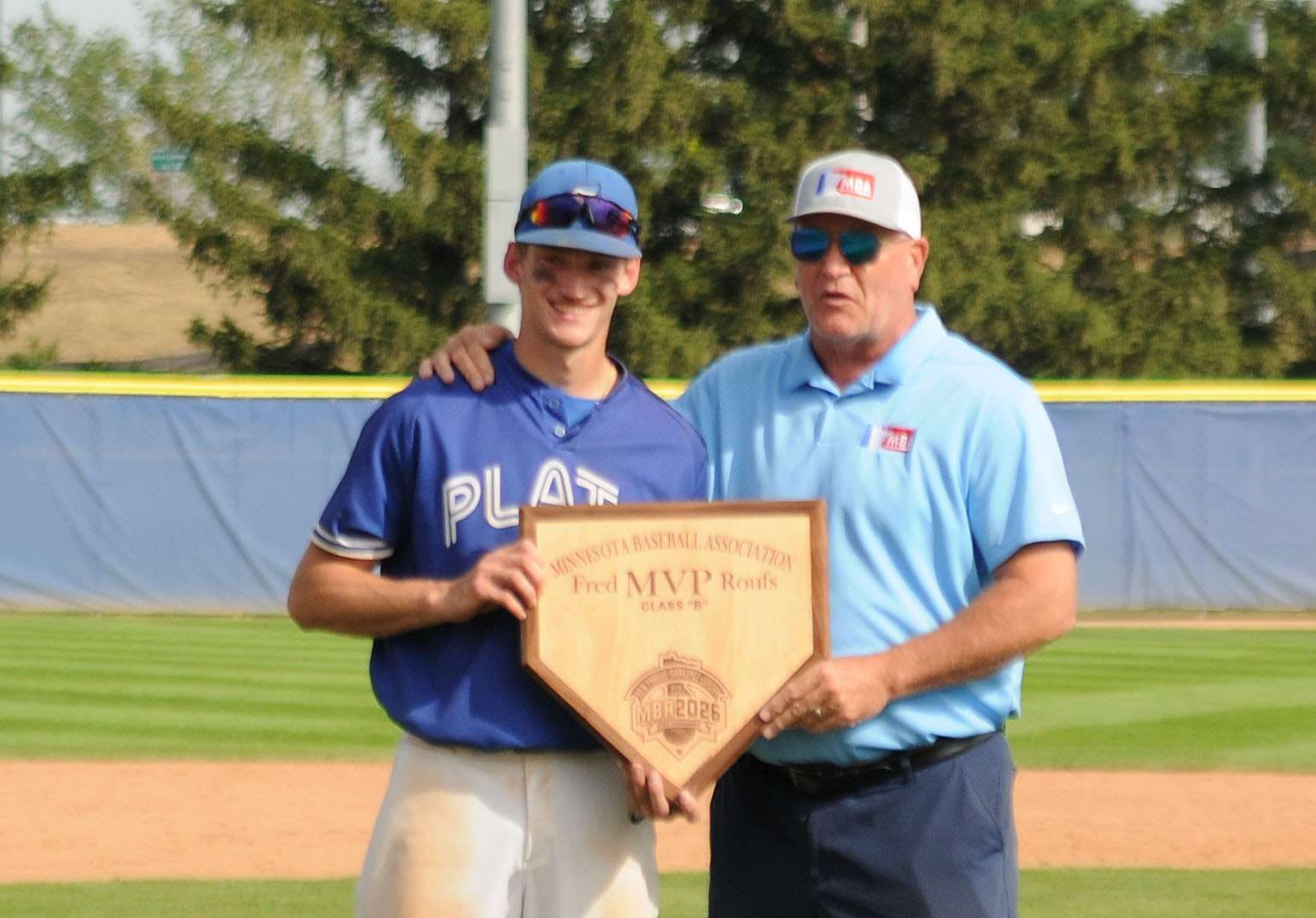
Class B tournament awards
Fred Roufs MVP and MaxBat Maple Slugger: Reece Schwirtz, Plato Blue Jays, 10-for-20, .500 average, 4 R, 1 2B, 3 RBI; 3-0, 29 IP, 21 H, 4 R, 3 ER, .93 ERA, 6 BB, 30 K Mike Davison Most Outstanding Pitcher: Max Otto, Delano A’s, 2-0, 18 IP, 6 H, 1 R, 0 ER, 3 BB, 24 K, 0.00 ERA JM and JD Sportsmanship Trophy: Watertown Red Devils Class B All-Tournament Team Clay Faber, Kimball Express Reed Marquardt, Cold Spring Springers (Chisago Lakes draftee) Jack Schafer, Sobieski Skis (Fort Ripley draftee) Joe Lucas, Jordan Brewers Derek Dahlke, Jordan Brewers Toby Hanson, Delano A’s Max Otto, Delano A’s Nick Hubbard, Plato Blue Jays (St. Boni draftee) Pat Tschida, Watertown Red Devils Adam Prehn, Plato Blue Jays Mike Foley, Watertown Red Devils Dayton Franke, Plato Blue Jays Chris Olson, Watertown Red Devils Beau Lepel, Plato Blue Jays Reece Schwirtz, Plato Blue Jays
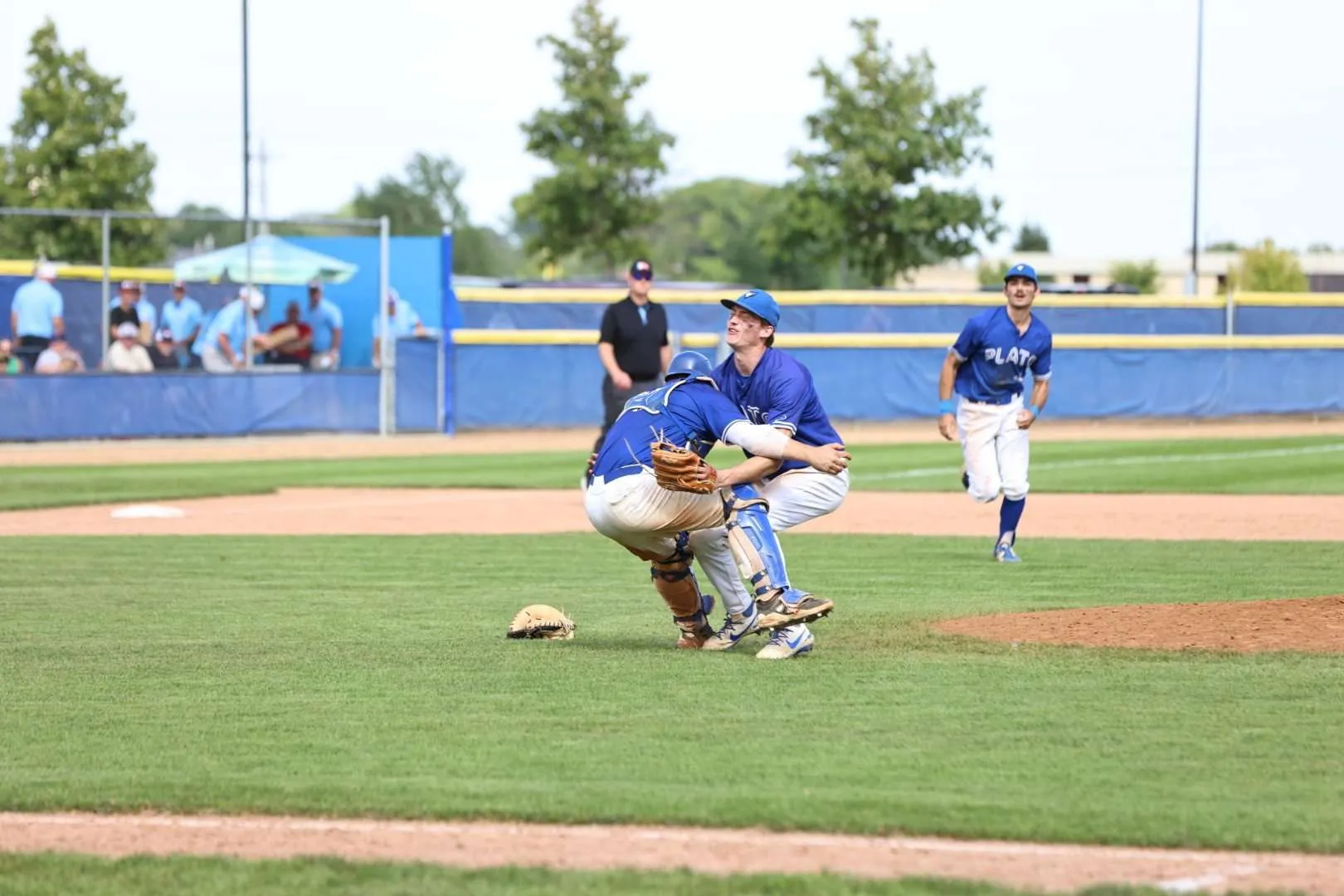
NEXT GEN: Plato cements new legacy with state title
By Nick Gerhardtnickgerhardt@mnbaseball.org In some ways Plato might’ve been a team of destiny this season. In 1996, the Blue Jays won their first state championship with Dave Franke and Dean Schwirtz earning all-tournament team honors with Franke garnering tournament MVP honors. Thirty years later, their sons, and the sons of four other members from that team accomplished the same feat as Plato defeated Watertown 13-1 to clinch the Class B state title at Joe Schleper Stadium in Shakopee. “It’s always been talked about,” Blue Jays manager Nolan Lepel said. “For them to repeat, it’s been amazing. They didn’t shy away from pressure and we played defense all tournament.” Reece Schwirtz earned tournament MVP honors after going 3-0 with a .93 ERA in 29 innings. He allowed just four runs, three earned, while allowing 21 hits, six walks and striking out 30. His tournament performance included an 11-inning complete-game start in a 2-1 win over Stewartville-Racine, a 5-3 win over Webster and eight shutout innings against Cold Spring Saturday in a 6-0 win. He closed out the championship win with an inning of relief where he struck out two and didn’t allow a hit or walk. “Reece has been a bulldog,” Lepel said. “He’s been dominant on the mound and then been dominant at the plate. He’s been the sparkplug, kept us running.” He did it at the plate, too, going 10-for-20 in the tournament with four runs, three RBI and one double. In the last two games he went 7-for-7 with three RBI and scored the game-winning run in a 3-2, 12-inning win over Delano in the semifinals. “When you’re not pitching you gotta step up somewhere,” Schwirtz said. “I was seeing the ball well, the batter’s eye is huge, being able to see a spin and put the ball in play.” The Frankes got things going in the last two games as Dayton drove in two runs against the Red Devils and provided the game-winning hit over Delano while Dawson drove in one run against the A’s and in the championship game. Meanwhile Plato got a stellar start from St. Boni draftee Nick Hubbard, who went eight innings and allowed one run on eight hits, walked one and struck out three. He got the start for St. Boni in the district playoffs when Watertown rallied from a four-run deficit in the eighth inning to secure its first trip to state since 2022. “I told Hubbard, keep them off-balanced,” Lepel said. “He’s not an over-powering pitcher. He did beat us twice during the year. I said, you keep guys off-balance two to three times through the lineup and we’re going to win. Reece was going to come in at some point. Reece was ready. I think if Reece had to go in the second, he would’ve.” With Hubbard cruising through eight innings and the bats cooking for the Blue Jays, they didn’t need Schwirtz until the end as they built a big lead. Plato grabbed a 1-0 lead in the top of the first inning after Schwirtz singled to score Tate Wischnack, who singled with two outs. The Blue Jays added three runs in the fifth inning after Beau Lepel got hit by a pitch. After a sacrifice bunt from Schwirtz, Brady Graupmann got hit by a pitch and Bennett Lepel reached on an error to load the bases for Dayton Franke, who singled in a run. Dawson Franke brought in another run on a fielder’s choice and Dane Schwirtz’s single scored Lepel to make it a 4-0 game. Plato added to the lead in the top of the sixth after Lepel drew a one-out walk and Reece Schwirtz doubled to the gap in left center. The Blue Jays remained relentless and added two more runs in the seventh after Luke Roepke plated Dawson Franke on a ground out and a wild throw to third base allowed Dane Schwirtz to score to build a 7-0 lead. In the eighth, Reece Schwirtz hit a lead-off single and scored on a double from Dayton Franke, for his second RBI of the game and made it 8-0. Watertown finally got on the board in the bottom of the eighth when Zach Iten hit a lead-off single and a Ryan Hangartner double brought him in. Plato tacked on five runs in the top of the ninth with Bennett Lepel knocking in two runs and Beau Lepel driving in a run with a double. An error allowed Beau Lepel to score and wild pitch allowed Reece Schwirtz to score. Watertown pitchers struggled to get on track. The Red Devils used six different pitchers who hit five batters and walked six. Watertown had a threat in the fourth inning after Ryan Hangartner hit a lead-off double, but after a fly ball to center field, Jordan Berrios lined into an inning-ending double play. Plato entered the state tournament as the No. 4 seed from District 7 after Watertown won a seeding game 8-1 over the Blue Jays for the No. 3 slot. Three of the final four teams in Class B came from the Crow River Valley League with Delano making the semifinals. Plato secured its fifth state title in club history after winning the 1996, 2007, 2015 and 2018 titles. The Red Devils reached the state championship game for the first time since 2021 when they fell 3-0 to Sobieski in 11 innings. The Blue Jays reached the title game for the first time since 2018 when they defeated Sobieski 8-5. The state tournament drew a total of 29,075, the most since 1953 and eclipsed the latest high total of 2023 when 28,007 fans attended the tournament. The 1953 tournament in New Ulm drew 31,031.